
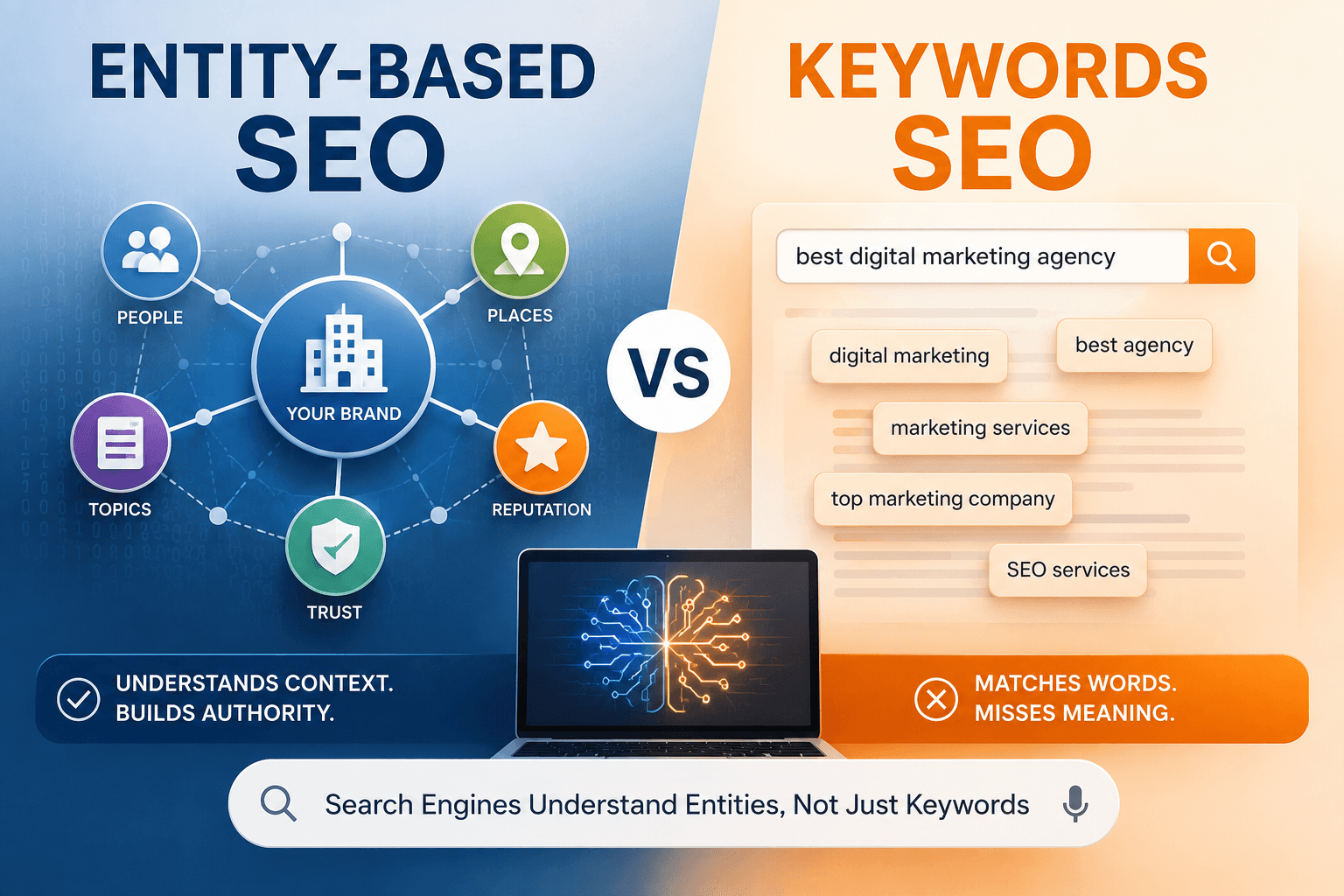
The playbook for ranking on Google was pretty simple for over two decades: pick a popular search phrase, strategically place it in your headings, and sprinkle it throughout your paragraphs. But search engines have evolved. They no longer think of web pages as collections of character strings and patterns of text. They regard the web as a web of real-world concepts, relationships and identities all interconnected.
Welcome to the age of Semantic SEO, a paradigm shift from text matching to real conceptual understanding. Algorithms today don’t just search for individual terms; they map out entities to see how deep your brand’s expertise and structural authority go.
If your digital growth strategy is still 100% based around legacy search phrases, you are leaving a lot of organic reach on the table. Let’s break down why Google cares more about who you are than what you type and how refreshing your approach can revolutionize your online presence.
What Exactly is an Entity in Modern Search?
Before we get into why search engines changed their behaviour, it helps to understand what an “entity” is in the context of modern optimization. According to Google’s official documentation, an entity is a well-defined, unique and distinguishable thing. It doesn’t have to be a physical thing; it could be a person, a place, an organization, a concept or a specialized service.
Traditional optimization is like the index cards in a library. Entity-based optimization is like a massive, interconnected digital brain. The brain is powered by Google’s sophisticated Knowledge Graph, a database that maps entities and their relationships.
For instance, Google doesn’t just see WireTree as a word on its own. It recognizes it as a distinct professional outfit based in Ontario and understands its inherent connection to areas such as web development, custom software design, and specialized SEO solutions in Toronto.
Why Search Engines Are Shifting Away from Basic Keyword Matching
The move toward concept-driven indexation was just a matter of necessity. The old way of doing optimization had some obvious flaws that hurt the user experience:
- Contextual Ambiguity: Words have more than one meaning. The word Apple could refer to the fruit, the multi-trillion-dollar tech company, or a historic record label. Keywords alone cannot resolve that confusion definitively.
- Vulnerability to Gaming: Standard systems could easily be gamed by unnatural repetition of text, with a tendency to favour shallow, low-quality content over true subject knowledge.
- Conversational Queries Increasing: With the rise of mobile voice search and generative AI tools, people now seek answers using whole sentences rather than broken word combinations.This allows Google to understand the intent of a query by prioritizing entities. It looks at the context of a search to deliver the right information, in the right way, to exactly what the user is actually seeking.
Keywords vs. Entities: A Quick Comparison
To see how these two methodologies operate in practice, let’s look at how they approach content creation and indexing side-by-side:
Feature Traditional Optimization Entity-Based Strategy Core Focus Individual search terms and variations Real-world concepts and clear topics Search Engine Action Counting character strings on a page Mapping topical relationships and context User Value Often leads to repetitive, thin content Delivers deep, comprehensive insights Long-Term Stability Highly vulnerable to algorithmic updates Builds lasting digital brand authority How to Optimize Your Digital Footprint for Semantic Search
Turning your website into a concept-driven structure isn’t simply a matter of updating text. It asks you to create a coherent, authoritative network of information throughout your entire digital footprint. Here is a systematic way of implementing this approach:
1. Cover Topics Fully, Not Just Phrases
When you’re writing a new piece of content, don’t just target one search term. Rather, attempt to cover the whole subject area in detail. Identify natural sub-topics, answer common follow-up questions, and include related concepts that an industry expert would naturally discuss. This holistic approach tells search algorithms that your website is a high-quality, trustworthy resource on the topic.
2. Strategic Use of Schema Markup
Search engine crawlers are direct translators of structured data. Adding Schema markup (Organization, Product, Article data, etc.) is how you tell search engines what your assets are, how they relate and who created them. Schema lets you explicitly state your location, professional team, and key business offerings to help Google’s Knowledge Graph verify your identity.
3. Establish A Strong Internal Link Structure
How you link your pages creates a map that determines your site’s structural authority. Rather than linking pages at random, build out separate topical hubs. Link your general information posts back to your specific service pillars, like your dedicated Search Engine Optimization Services Toronto page. This organized flow allows topical equity to be distributed naturally throughout your domain.
4. Focus on Google’s EEAT Framework
Google’s Helpful Content system is designed to place heavy weight on signals of Experience, Expertise, Authoritativeness, and Trustworthiness (EEAT). Search engines are looking to see whether the brand has a proven track record in its market. Clear author profiles, citations to verified data, real customer reviews, and accurate, up-to-date service information can all help establish this trust.
How a Specialized SEO Company in Toronto Drives Real Results
Transitioning from legacy word matching to a rich, entity-based system is a complex process that requires both engineering rigour and a strategic digital roadmap. A one-size-fits-all approach to optimization just won’t work in today’s competitive online world.
Being a full-service digital agency with a long history, an experienced SEO company in Toronto understands how to coordinate your website architecture with Google’s modern semantic standards. From delivering clean, structured schema to designing responsive, high-performance layouts that keep users engaged, the right partner ensures your brand builds clear online authority that translates into sustainable organic growth.
Elevate Your Search Authority with WireTree
Search engines no longer just index plain text; they develop long-term relationships with trusted digital brands. If you want to beat your competition consistently, you need your website to be seen as an authoritative source in your niche.
At WireTree we employ the perfect blend of technical precision and sophisticated optimization strategies, so search engines are able to determine exactly who you are, what you do well and why you are the best choice for your clients. Whether you’re looking to fix underlying technical issues, overhaul your content strategy or build a high-converting website from scratch, our team is here to help you succeed.
Want to get more visibility in search? Contact WireTree today for a free consultation and let’s create a digital strategy that builds lasting authority for your business.